Product Overview
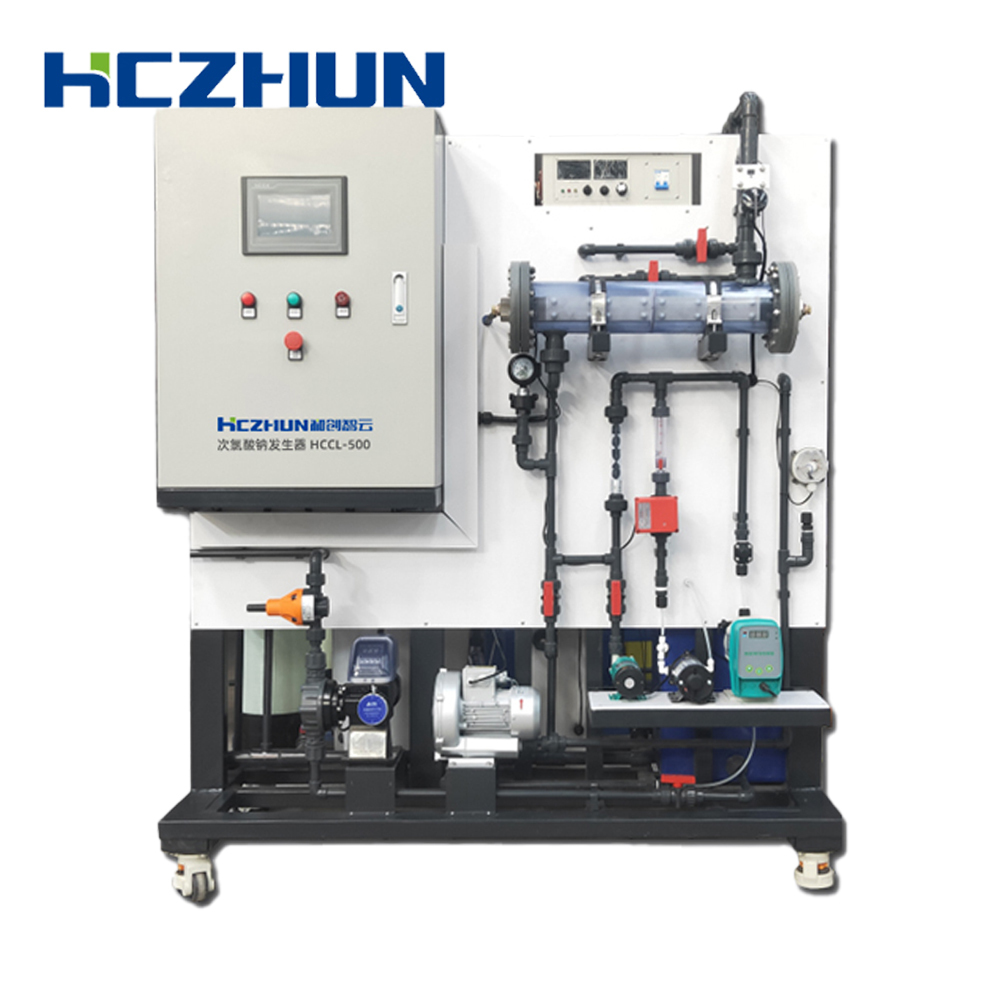
A plant room that grew up around delivered hypochlorite drums rarely has a spare metre for a softener, a brine tank, a dosing set and a generator cabinet lined up separately along the wall. Putting that whole train on one base frame is what this build is for: salt dissolving, brine preparation, electrolysis, dosing and hydrogen exhaust are assembled, piped and run together before the unit leaves the works. Salt, water and power go in, and low-concentration sodium hypochlorite comes out and is metered straight into the process. Running an on-site sodium hypochlorite generator this way takes drum deliveries, chemical storage and the handling of a bought solution out of the daily routine, and it puts production under the plant's own control. The build suits a site with a defined disinfection duty and a plant room that is tight but real: a municipal works adding a duty point, an industrial plant disinfecting its own effluent, a hospital, estate or public building served by a packaged treatment set. If you are weighing up sodium hypochlorite generator manufacturers, the differences that matter show up on site rather than on a data sheet: what arrives already piped, how many suppliers you have to coordinate on one installation, and how much commissioning happens in the factory instead of in your building. We fabricate the frame, the cells and the control cabinet, and we build the train around the room you actually have.
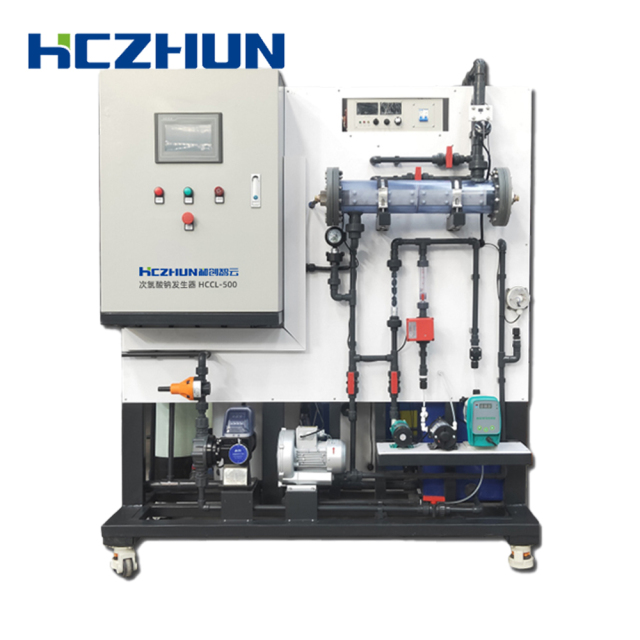
Frame & Skid Layout
- Brine preparation rides on the frame: the salt feeder, salt dissolving tank and dissolving pump sit a few steps from the cells, so brine is made where it is used rather than carried across the plant room.
- Water conditioning belongs to the same train: a water softener and soft water stabiliser sit ahead of the brine dispenser, because hardness is the usual reason a cell scales up and loses output.
- Generation and dosing are neighbours: the generator cabinet and the sodium hypochlorite dosing system share the base, so the solution leaves the cells and enters the metering set through a short, visible run of pipe.
- The hydrogen exhaust fan is mounted with the assembly, which forces the vent route to be settled while the layout is still on paper instead of after the unit is standing in the room.
- An acid washing machine is part of the arrangement, so descaling uses equipment that belongs to the skid rather than a borrowed pump and a bucket.
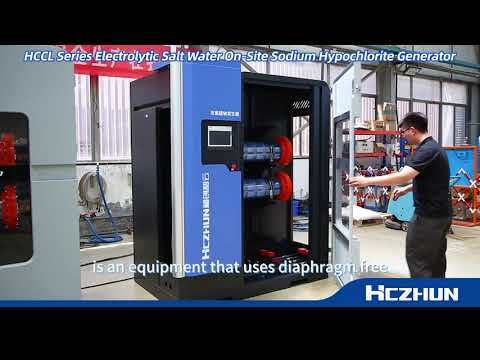
- Hinged double doors open the full front of the cabinet onto the electrolysis cylinders, the control panel sits at working height, and the analogue gauges and valves on the manifold can be read without crouching.
- The assembly is floor-standing on a skid base, and the smaller frames sit on castors so the unit can be rolled to its final position, fixed down and levelled before the pipework is connected.
- Pipe stubs, cabinet side and dosing orientation are set to the room, which is what makes this a custom sodium hypochlorite generator rather than a fixed shape you have to build around.
Safety & Gas Handling
- Hydrogen is a normal product of brine electrolysis, so a hydrogen exhaust fan is mounted with the train and the discharge is ducted to a safe outdoor point; the route is agreed at drawing stage, before ducting has to be threaded through a finished building.
- Because brine strength, cell power and exhaust are managed from one cabinet, a packaged sodium hypochlorite generator is started and stopped as a train rather than as separate machines switched on by different people.
- Water safety sits at the front end.
- Softening and stabilising ahead of the dispenser keep hardness out of the cell, where scale would otherwise raise resistance and heat.
- The acid wash runs to scheduled intervals set in the control system, which reduces how often anyone has to open acid containers or handle wash solution by hand.
- Room-side practice counts as much as the machine: a drained and washable floor, ventilation to the outdoors, clear access to the cabinet doors and a marked vent discharge are the points most often raised in a safety review.
- Operators are trained on one panel and one set of valves instead of separate brine, generation and hypochlorite dosing equipment, which is usually what shortens the handover on a packaged skid.
Control & Automation
One cabinet runs the train. Brine strength, cell current and dose rate for the brine electrolysis are held from the panel, so the operator sets the duty instead of nursing three separate machines through a shift.
A two-way IoT link reports the operating state of each part of the sodium hypochlorite generator, with remote cloud access, PC-based group monitoring and a mobile app. That matters where one technical team looks after several small plants and cannot be in every plant room.
Pickling is scheduled from the control system and carried out by the acid washing machine on the frame, which keeps descaling on a routine rather than waiting for a visible drop in output.
The screen does not replace the basics. Analogue gauges and manual valves on the manifold let an engineer read pressure and flow by eye and take local control during commissioning or a sensor change.
Signal lists, set points and the remote arrangement are entered at commissioning, so tell us while the panel is being specified which signals your plant SCADA or DCS needs to see and in what form.
Site Fit & Installation
- Measure the route before the delivery date is fixed: door widths, corridor turns, lift capacity and the crane or forklift position outside the building decide how the custom sodium hypochlorite generator has to be presented on the day.
- Set the skid on a flat, drained floor, level it, fix it down on the anchor points shown on the general arrangement, and only then connect raw water, drain, power and the vent duct.
- Run the vent to the outdoor discharge point and the dosing line to the process connection, with isolation valves where your site rules call for them.
- Fill and leak-test the brine train, set brine strength and cell current, and confirm the dosing pump delivers against the head at your injection point.
- Enter set points, alarm limits, the pickling schedule and the remote link, then run a full cycle with the operators who will actually use the unit.
- Record the first-run readings — brine strength, cell current, dose rate and line pressures — and keep them as the baseline for every later comparison.
- If the duty may grow, leave the clearance a larger frame will need: the same platform is built as a high capacity sodium hypochlorite generator, and it has to come through the same door.
Specifications
| Model reference | HCCL-50-500 |
| Configuration | Brine preparation, electrolysis, dosing and hydrogen exhaust assembled on one frame |
| Generation method | Brine electrolysis without a diaphragm, from dilute brine, producing low-concentration sodium hypochlorite as it is needed |
| Available chlorine output | Matched to your duty point and stated on the approved data sheet for the build, whether a standard frame or a high capacity sodium hypochlorite generator |
| Salt feed | Salt feeder, salt dissolving tank and dissolving pump mounted on the frame |
| Water conditioning | Water softener and soft water stabiliser ahead of the brine dispenser |
| Brine preparation | Dilute brine dispenser feeding the electrolysis cells |
| Cell cleaning | Acid washing machine on the frame for scheduled descaling |
| Dosing | Sodium hypochlorite dosing system mounted with the generator |
| Ventilation | Hydrogen exhaust fan on the frame, ducted to a safe outdoor discharge point |
| Controls | Integrated control cabinet with screen panel, analogue gauges and manual valves |
| Electrolysis cell | Cylindrical cells inside the cabinet, reached through hinged front doors |
| Installation | Floor-standing skid base with castors on the smaller assemblies |
Technical Data & Downloads
| Specification sheet | Model reference, confirmed output, and salt, water and power consumption for your build |
| General arrangement drawing | Frame footprint, anchor points, pipe stubs and cable entries |
| Process diagram | The train from softener and brine dispenser through the cells to the dosing point, with the vent route shown |
| Utility schedule | Raw water, drain, power supply and ventilation requirements at the frame |
| Control description | Panel functions, signals available to plant SCADA or DCS, and the remote access arrangement |
| Installation and commissioning guide | Setting, alignment, first-run checks and set-point entry |
| Operation and maintenance manual | Pickling routine, cell inspection, spares list and fault finding |
| Current datasheet | Ask our team for the sheet for the build you are planning before the plant room layout is frozen |
Ordering & Delivery
- Send the duty point first: flow, target dose or residual, hours of operation and the water quality figures you already hold.
- Sodium hypochlorite generator manufacturers can only size a frame properly against those numbers, so send what is firm and mark the rest as estimates.
- Send the room as well: photos or a sketch showing free floor area, the drain, the power available, the process connection and where the vent can discharge.
- We come back with a configuration and a quotation.
- Approve the drawings before fabrication.
- Agree packing, shipping and delivery terms with your sales contact, including the port of discharge and the person who will receive the unit on site.
- Confirm payment terms and the documentation you need for the project file, then plan the unloading day: lifting equipment, floor protection and a site contact to sign off the set-down.
Technical Support & Model Matching
Send us your duty point, available utilities and site constraints, and our engineers will match a model from our range and confirm the configuration with you before anything is built — including custom designs where the project calls for it. That support continues after delivery: our technical team assists with installation and commissioning guidance, operator handover, fault finding and spare-part replacement, and we provide the drawings and specifications your project team needs. Share your process details and we will come back with a recommended model and a clear technical proposal.
FAQ
What salt does the unit need, and how is it fed in?
Salt is dissolved in the salt dissolving tank, drawn forward by the dissolving pump and diluted to brine strength at the dispenser before it reaches the cells. Grade matters, because additives and caking agents have no place in a brine train, so confirm the grade with our team against what your local supplier can deliver. Consumption for your project is stated on the specification sheet for the confirmed build rather than quoted as a general figure.
Where does the hypochlorite go once it has been generated?
Into the dosing set mounted on the same frame, which meters it into your contact tank, pipeline or reservoir at the injection point. If your process needs a day tank or a storage volume between generation and dosing, that is settled in the layout and the drawing rather than added after the unit has landed.
How is hydrogen vented if the plant room has no outside wall?
The exhaust fan collects hydrogen at the frame and discharges it through ducting to a safe outdoor point. Where there is no direct wall, the duct route up through a roof slab or along a service corridor is worked out on the general arrangement, so bring the building constraint to us early, while the drawing is still open.
Can the frame be arranged around a plant room that is already built?
Yes. Pipe stubs, cabinet side, dosing orientation and the space left for service access are all set on the drawing, and a custom sodium hypochlorite generator is arranged around those constraints rather than around a fixed catalogue footprint. If the door route or the ceiling height is tight, say so when you send the room details and the build is planned around it.
What happens if the plant expands beyond this build's output?
Raise it at the ordering stage. The same platform is engineered as a high capacity sodium hypochlorite generator for larger duties, and knowing that early changes the floor space you leave free, the vent size you install and the electrical capacity you plan for now.
Which figures should we compare when talking to sodium hypochlorite generator manufacturers?
Compare available chlorine at your duty point rather than a headline maximum, then salt, water and power consumption per kilo of chlorine, what the control cabinet includes, whether venting is inside the supply, and how much of the train arrives pre-piped on the frame. Ours are stated for the confirmed build on the specification sheet, so both sides are comparing the same duty.
Does the remote monitoring need a permanent internet connection?
An on-site sodium hypochlorite generator runs its sequence from the cabinet on site, and the cloud link is what adds remote viewing and app control. If your site network is restricted, tell us when the panel is specified so the connection arrangement can be agreed with your IT team.