Product Overview
A coagulant dose that drifts by a few percent is enough to push a clarifier into a cycle of overdosing and correction, and the cause usually sits in coagulant preparation rather than in the process. PAC tipped into a tank by hand, or a feeder running open loop, produces a solution whose strength changes from batch to batch, and every downstream adjustment is really chasing that change.
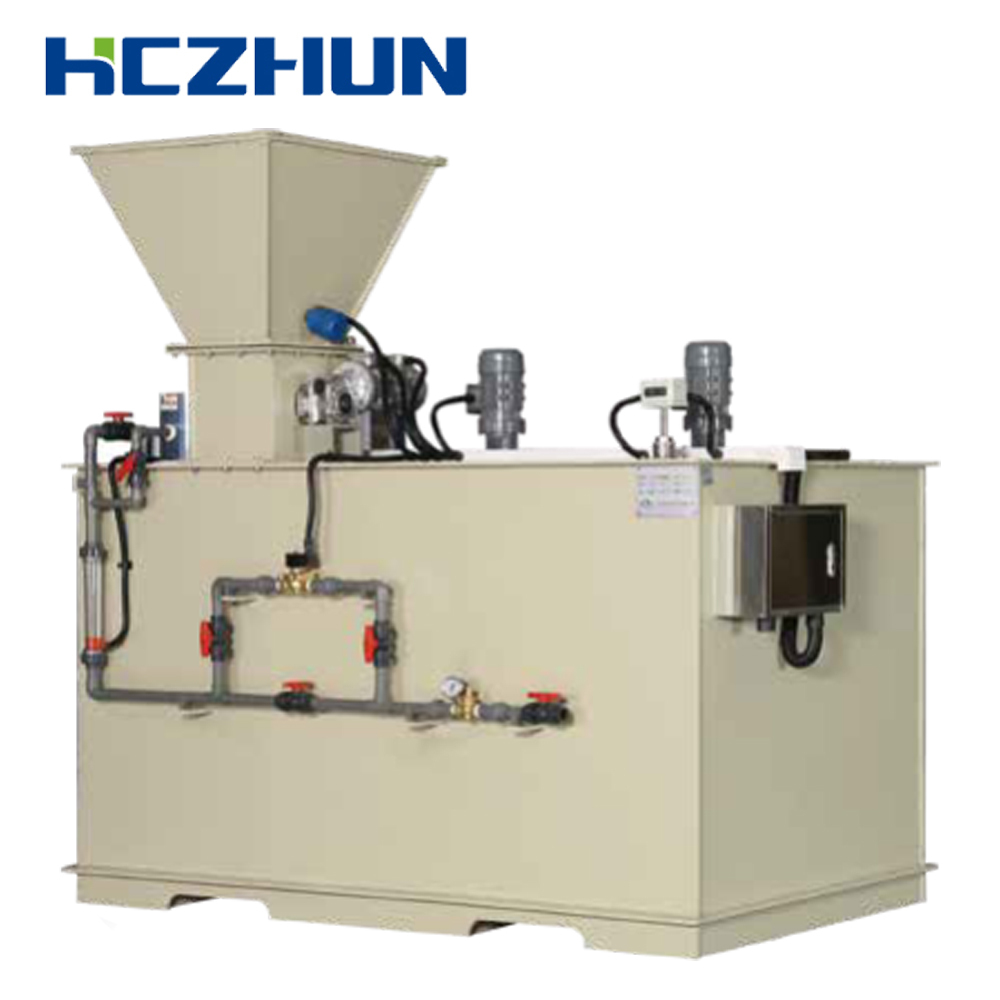
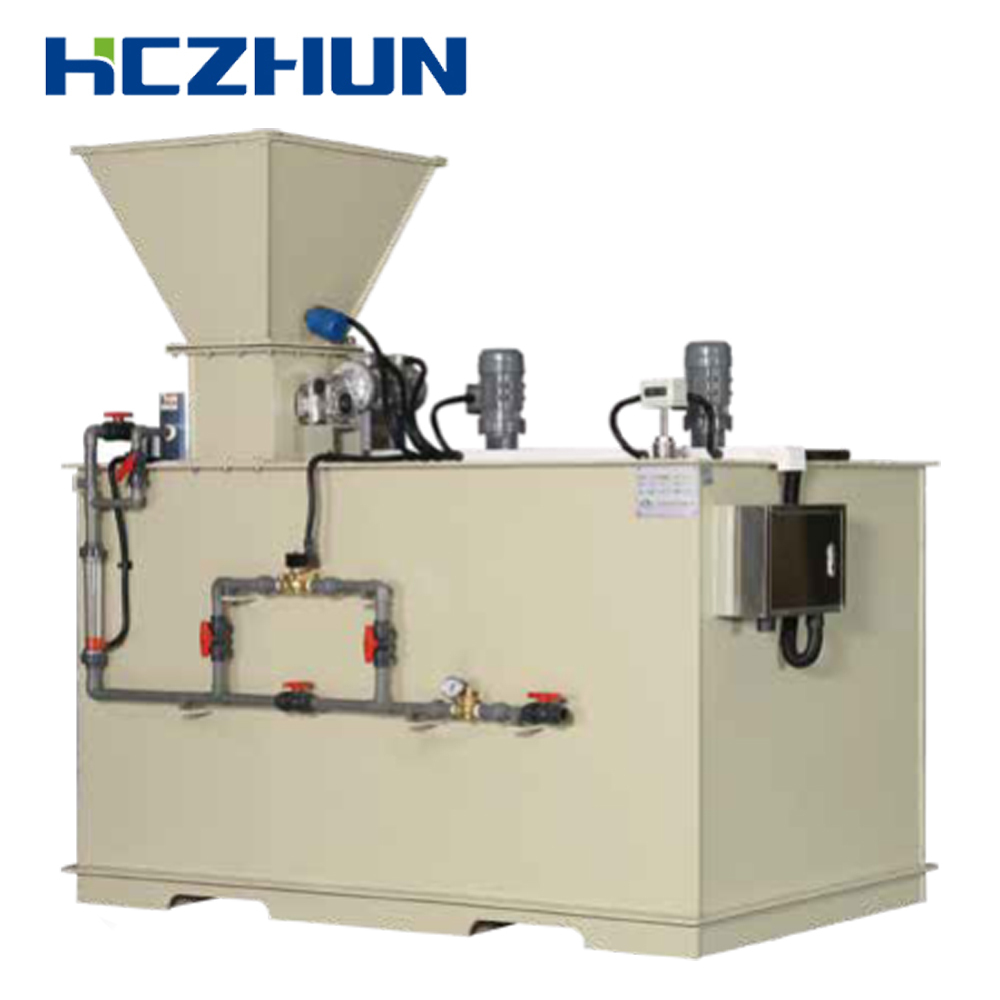
Metering the powder by weight, wetting it before it reaches the tank and letting the batch mature into a consistent working solution takes most of that variation out before it ever reaches the dosing point. This unit brings the sequence together on one frame: a powder hopper, a spiral feeder, a wetting and pre-mixing section, a dissolving tank with mixer, metering pumps and a PLC cabinet. Powder goes in at the top, matured solution leaves through the pumps, and preparation runs as an automatic PAC dosing system instead of a manual batch.
Waterworks dosing ahead of sedimentation, municipal wastewater plants tightening discharge quality, industrial sites treating process or effluent water and chemical processors feeding coagulant continuously all share one requirement: the strength at the injection point has to be right, not just the strength in the tank. Five preparation capacities cover small works through large municipal plants, so the same platform serves a packaged plant and a full chemical room.
Projects usually arrive from one of two directions — a hand-batching arrangement being automated, or a tender specifying a packaged dosing room. Either way the hardware will look familiar to anyone who knows us as PAM dosing system manufacturers: same feeder design, same hopper layout, same control cabinet, with the wetting, tank volume and pump selection matched to coagulant duty.
Preparation Cycle
- PAC powder is loaded into the hopper from the top and the lid closed again between refills, which keeps the batch from picking up moisture while it waits.
- The target solution strength and the dosing ratio for your water are entered on the touchscreen, and the unit takes over the fill, powder dosing and mix sequence from there.
- Powder meets water in the pre-mixing section and passes into the dissolving tank, where the mixer keeps the batch moving until the powder is fully taken up.
- The batch is held for more than an hour under the specified preparation amount and continuous dosing conditions, and by the end of that period the solution is thoroughly matured — a matured solution is what makes the downstream dose repeatable.
- Metering pumps draw matured solution from the tank and deliver it to the injection point ahead of clarification, sedimentation or the next treatment stage.
- The cycle restarts as the tank empties, so the plant keeps a working solution on hand and the unit behaves as a continuous automatic PAC dosing system rather than a batch that has to be started by hand.
Technical Advantages
- Closed-loop powder feed — the spiral feeder corrects its own speed against the volume it is actually delivering, so the set feed rate on this automated dosing system holds instead of drifting as powder density and hopper level change.
- Powder handling for humid rooms — a silo vibrator keeps PAC moving down to the feeder and a heating and moisture-proof device holds it in condition while it waits, while a water–material pre-mixing device wets the powder on contact, so it hydrates properly during coagulant preparation instead of forming lumps.
- Dose that follows the plant — dry powder dosing automatically tracks changes in influent flow rate, so the prepared solution holds a constant concentration when plant load moves instead of needing a manual correction.
- Fault alarm and automatic shutdown — when the control system detects a fault it alarms and stops the sequence, so a dry hopper, a stalled pump or a blocked line does not quietly become a spoiled batch; the alarm and stop logic follows the same pattern as our PAM dosing system.
- Compact integrated body — the three-channel overflow integrated structure brings wetting, mixing and storage together on a small footprint, which keeps the chemical room layout simple and maintenance access short.
- Components chosen for continuous duty — the accessory set uses imported components, which counts on a machine running day after day in a damp, chemical atmosphere.
Siting & Installation
- Prepare the floor and drainage — the skid sits on a level, load-bearing slab, with a floor drain or bund close to the overflow and drain connections for wash-down and spill water.
- Because it is one item inside a train of custom water treatment equipment, check the room layout against the neighbouring stages before the slab is poured.
- Allow working room — leave space at the hopper for refills, at the control cabinet for the operator and at the pumps for maintenance; where the room already holds a PAM dosing system, keep enough distance between the two skids that powder from one does not settle on the other.
- Confirm water and power — the water inlet size follows the capacity you select, and the electrical supply is checked against the motor and control ratings before the cable is pulled.
- Run the dosing main — take the line from the metering pumps to the coagulant injection point and pressure-test it before start-up.
- Dry-run the sequence — with water only, step the unit through fill, mix and transfer on the touchscreen so the whole coagulant preparation sequence is proven, and confirm that the alarms and the overflow behave as expected.
- Commission on real powder — load PAC, set the solution strength and dosing ratio for the duty, and let the first batch mature fully before it goes to process; that batch becomes the reference for every one after it.
Application Areas
- Waterworks — coagulant dosed ahead of sedimentation takes colour and turbidity out of surface water, and the working solution stays at strength when raw water quality shifts after heavy rain.
- Municipal wastewater — tertiary and advanced stages use coagulant for phosphorus and suspended solids removal; an automatic PAC dosing system holds the solution at strength through the plant's diurnal peaks, when a hand-batched tank tends to run lean.
- Industrial wastewater — plating, textile, paper and food plants use coagulant ahead of their own clarifiers or dissolved air flotation units, where a batch that is started and then forgotten is a common cause of poor separation.
- Chemical processing — coagulant serves product clarification and washing duties as well as effluent treatment, and the dosing ratio can be set for the stream in hand.
- Hospitals, residential communities and public buildings — small packaged plants use the lower preparation capacities where a full chemical room is not justified.
Specifications
| Preparation capacity | 1,000 / 2,000 / 3,000 / 4,000 / 5,000 L/h |
| Dry powder dosing rate | 1–3 kg/h at 1,000 L/h, 2–6 kg/h at 2,000 L/h, 3–9 kg/h at 3,000 L/h, 4–12 kg/h at 4,000 L/h, 5–15 kg/h at 5,000 L/h |
| Dosing ratio | 1–3‰ |
| Hopper capacity | Inlet Diameter&Min. Water Inflow |
| Minimum water inflow | 1,500 / 3,000 / 4,500 / 6,000 / 7,500 L/h across the five sizes |
| Inlet diameter | DN25 on 1,000 and 2,000 L/h, DN32 on 3,000 and 4,000 L/h, DN40 on 5,000 L/h |
| Main engine power | 2.5 kW / 1.4 kW on the 1,000 and 2,000 L/h sizes, 3.0 kW / 1.4 kW on 3,000 L/h, 3.0 kW / 2.5 kW on 4,000 and 5,000 L/h (domestic / imported mixer) |
| Main engine weight | 350 kg / 1,800 kg, 410 kg / 2,350 kg, 700 kg / 3,500 kg, 800 kg / 5,300 kg and 900 kg / 6,600 kg (no load / full load, in capacity order) |
| Overall dimensions (L × W × H) | 1800 × 1000 × 900 mm, 2050 × 1000 × 1050 mm, 2440 × 1220 × 1050 mm, 3150 × 1260 × 1260 mm and 3500 × 1400 × 1300 mm, in capacity order |
| Control | PLC-based dosing system with MCGS touchscreen |
| Communication | Industrial Ethernet interface for parameter upload and upper-level monitoring |
| Powder feed | Spiral feeder with silo vibrator and heating and moisture-proof device |
| Construction | Three-channel overflow integrated body on a single frame |
Documentation & Downloads
| Specification sheet | Capacity, dosing rate, hopper size, power, weight and dimensions for the size you select |
| Dimensional drawing | Overall footprint, base fixing points and connection positions for civil works |
| Connection schedule | Inlet, overflow, drain and dosing outlet sizes and positions |
| P&ID | Preparation and dosing flow with instrument and valve tags |
| Electrical schedule | Motor and control ratings, terminal list and site wiring details |
| Control description | PLC sequence, setpoints, alarm list and the Ethernet points used for upper-level monitoring |
| O&M manual | Start-up, routine checks and troubleshooting for the operating team |
| Spare parts list | Recommended first-set wear parts for the feeder, mixer and metering pumps |
| Downloadable specification | The current sheet for this model can be downloaded, and a copy goes out with every quotation |
Ordering & Delivery
Sizing comes before price. The design flow, the coagulant dose you are working to and the PAC powder specification decide which preparation capacity, hopper size and pump set appears on the order, so have those numbers settled before the specification is fixed. Units are built to order rather than shipped from stock, so the delivery date depends on the size, the control scope and whether the skid is part of a larger package. Confirm the current lead time and payment terms with your sales contact once the drawings are approved. Packing follows the route to site: a skid-mounted unit travels as a complete assembly where access allows, with the control cabinet and metering pumps protected for sea freight. Tell us how the site will be reached and offloaded so the packing suits it. Where a plant also doses polymer, both skids can come from one works. Decide where the supply stops before the order is placed — skid only, or skid with the injection point, dosing main and controls — and confirm which documents, spares and commissioning arrangements you want included in the scope.
Technical Support & Model Matching
Send us your duty point, available utilities and site constraints, and our engineers will match a model from our range and confirm the configuration with you before anything is built — including custom designs where the project calls for it. That support continues after delivery: our technical team assists with installation and commissioning guidance, operator handover, fault finding and spare-part replacement, and we provide the drawings and specifications your project team needs. Share your process details and we will come back with a recommended model and a clear technical proposal.
FAQ
Does the unit handle powdered PAC only, or can it take liquid coagulant?
The hopper, spiral feeder and wetting section are built around powdered PAC, which is how the unit meters by weight and prepares a consistent solution. If your coagulant arrives as a liquid, say so before the specification is fixed, because the feed and mixing arrangement has to be matched to it rather than adapted afterwards.
How do I work out which preparation capacity I need?
Start from three numbers: the design flow, the coagulant dose in mg/L and the solution strength you intend to prepare. Together they set the preparation capacity and the dry powder feed rate, and the chosen size also has to be able to supply the minimum water inflow it needs. Send the three numbers and we will confirm the size, including any headroom you want for future flow.
Can the unit report into our plant SCADA?
The dosing system has an industrial Ethernet communication interface for parameter upload and upper-level monitoring, so operating data can be passed to a plant system rather than read only at the cabinet. What travels over that link — run status, setpoints, dosing rate and alarms — is agreed at the design stage, together with the point list your integrator needs.
What does day-to-day operation involve?
Top up the hopper, check that powder is flowing freely at the feeder, watch the wetting section for build-up, and confirm the tank is drawing down and refilling on cycle. Metering pump stroke and dosing line pressure are worth a glance each shift. Most problems show up first as a change in solution strength, so a daily check against the setpoint catches them early.
Do you also supply polymer preparation equipment?
Yes. The polymer line comes from the same works, which is how many buyers first found us as PAM dosing system manufacturers. The two duties behave differently — coagulant is dosed ahead of clarification, polymer is dosed for sludge conditioning — so each skid is sized on its own duty and the two are supplied with matching spares and controls.
Can the dosing skid share pipework and controls with the stages around it?
It can. We build custom water treatment equipment for the full train, so the coagulant stage is designed with its neighbours in mind: the injection point goes where mixing conditions suit the next stage, the upstream flow signal feeds the dosing control, and drains and overflow are routed to suit the room. Share the process diagram and we will confirm the interfaces.
What should we do with the unit if the plant shuts down for several weeks?
Empty and flush the dissolving tank, the wetting section and the dosing main with clean water, clean out the hopper so no powder sits against the feeder, and leave the control cabinet closed and dry. On restart, prepare a fresh batch and let it mature fully before dosing resumes, because solution held over a long shutdown is not a reliable reference.