Product Overview
A plant room that already carries a compressor skid, a feed-gas manifold and a cooling circuit rarely has floor space left when another cabinet arrives. This unit is built for exactly that situation: the air supply, the oxygen feed, the cooling path and the high-voltage discharge sit inside one enclosure that is wheeled in, connected to water and power, and switched on.
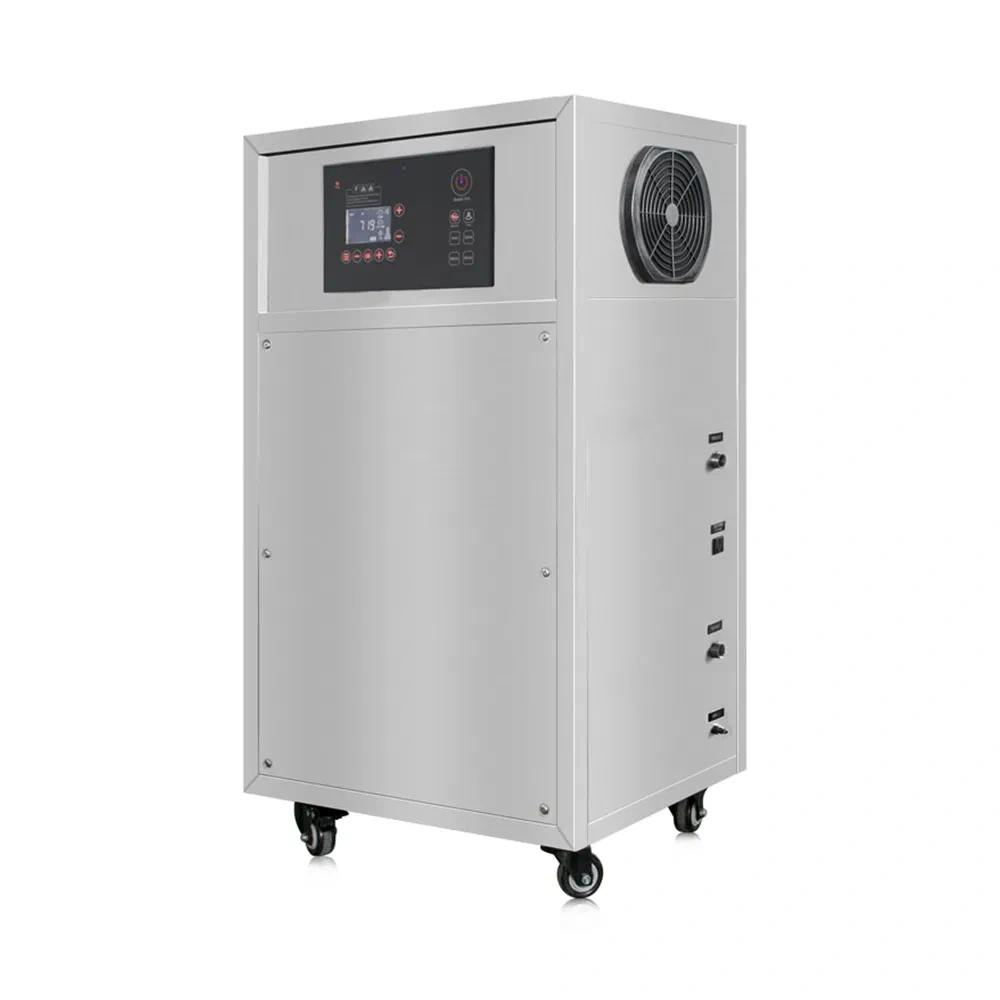
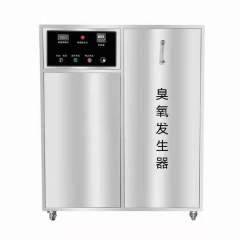
It is the smallest integrated ozone generator in our range — one cabinet rather than a generator plus a separate power supply and gas train — and it is issued under the model reference No.HMS-Y-50-200. The cabinet stands on the floor and can be bolted down as a fixed installation or kept on its castors.
Plant engineers and integrators buy it for a defined point duty: one injection point on this quartz tube ozone generator for water treatment, sized once and then left to run, rather than a whole treatment stage that needs its own ozone room and a full-time operator.
Two things decide whether this model is right — the ozone demand at your duty point and the services you can put beside the cabinet. Send both to our team; as an industrial water treatment equipment supplier we confirm the model, the fittings and the configuration in writing before the order is released.
Cabinet Design & Build
- Integrated air and oxygen supply.
- This integrated ozone generator has the oil-free air compressor, condenser and SPA oxygen system mounted inside the enclosure, so feed gas is prepared on board instead of on a separate skid standing beside the machine.
- Gas-water separator with automatic drainage.
- Moisture is knocked out of the feed gas and discharged without an operator opening a valve, which keeps the gas dry and protects ozone concentration between site visits.
- SPA oxygen system, 20 L/min.
- Oxygen-enriched feed gas is what lifts the discharge to the concentration the specification quotes, so the oxygen system is part of the machine rather than an optional extra bolted on later.
- Water-cooled honeycomb gap discharge tube.
- The ozone-producing element is cooled directly by the water circuit, which is what lets this water-cooled ozone generator hold its output through a long run instead of fading as the tube heats.
- 304 stainless steel shell.
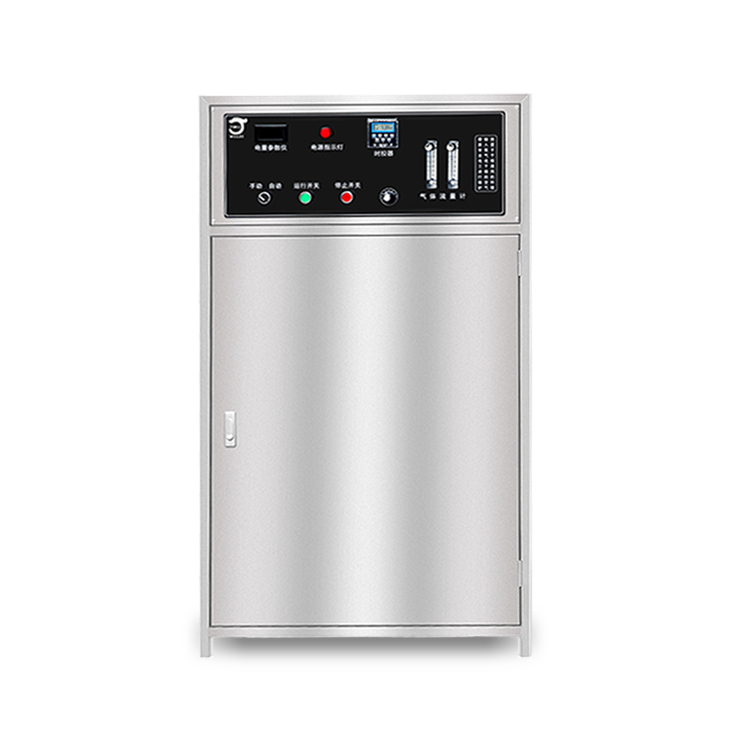
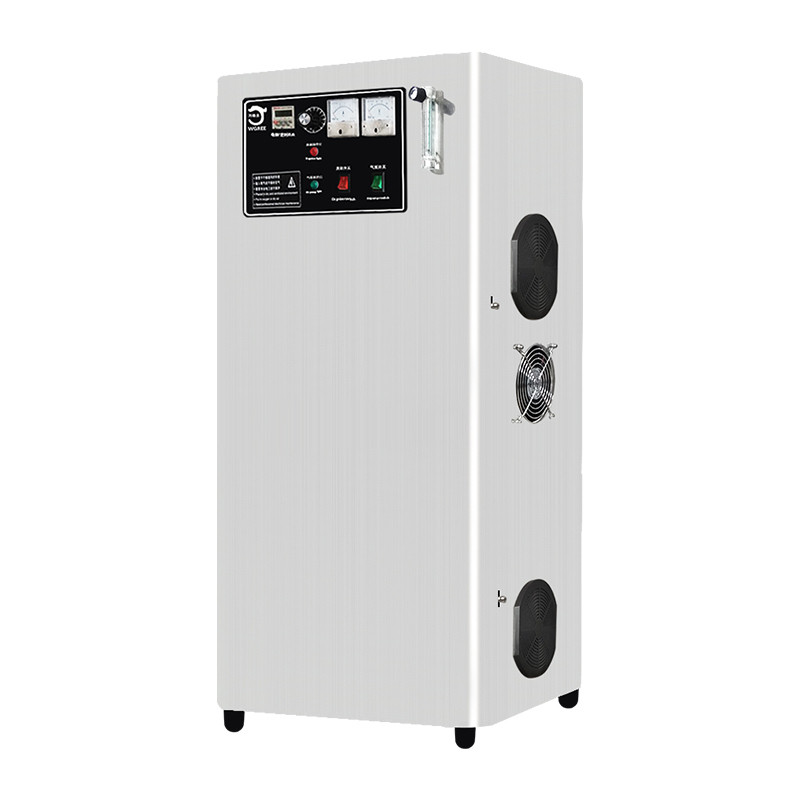
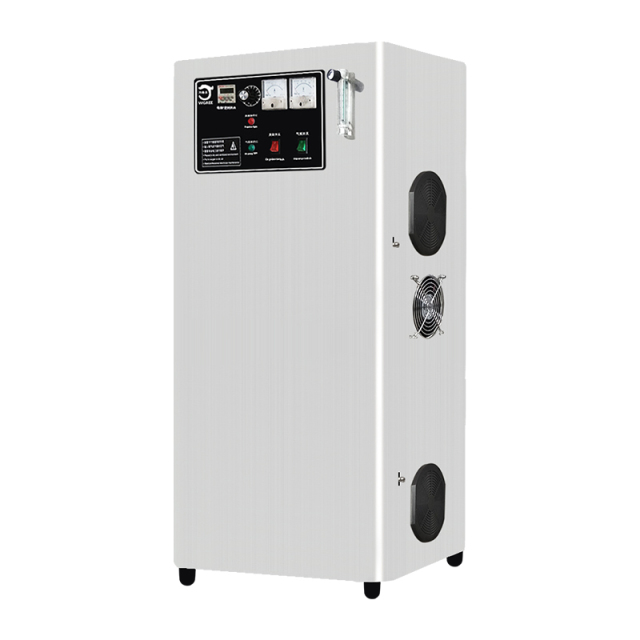
- The enclosure is 304 stainless inside and out — brushed, easy to wipe down, and chosen because an industrial ozone generator usually lives in a humid treatment room rather than a clean workshop.
- Ozone power supply and cooling fan.
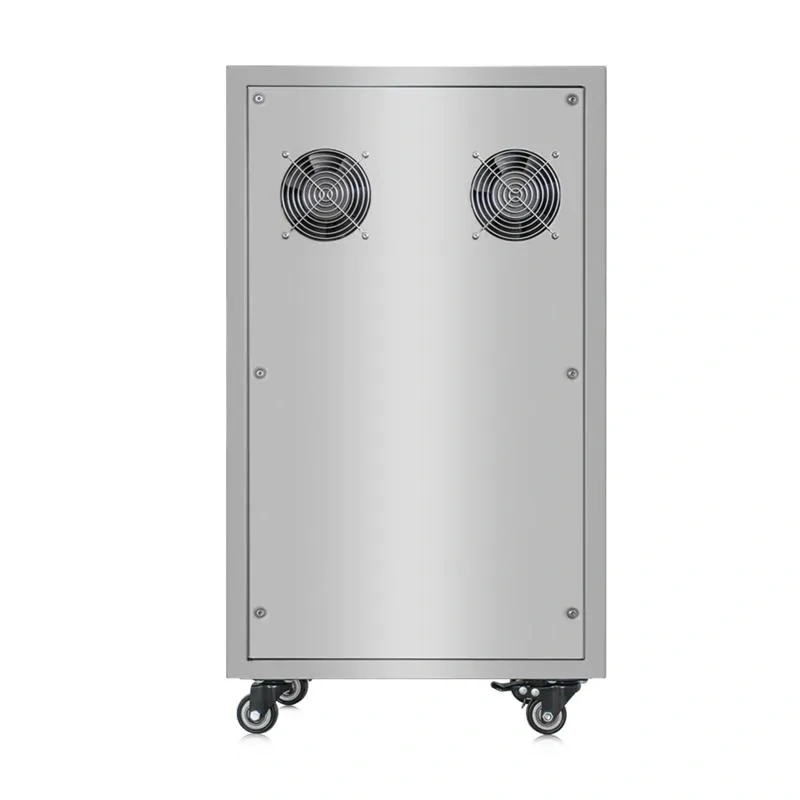
- A matched high-frequency power supply drives the discharge, and a cabinet fan moves air across the internal components so heat does not build up around the electrics.
- Floor fixed or mobile.
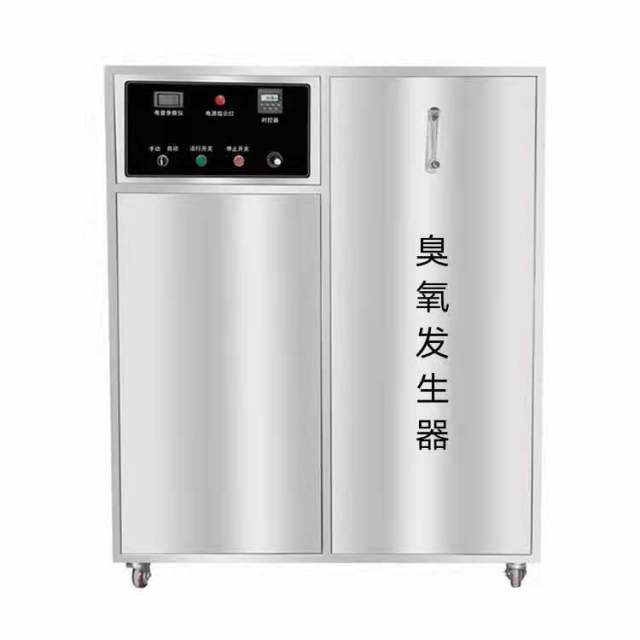
- The frame can be bolted down where the unit will stay for years, or left on its castors so it can be pulled forward for cleaning and service access.
- Front service access.
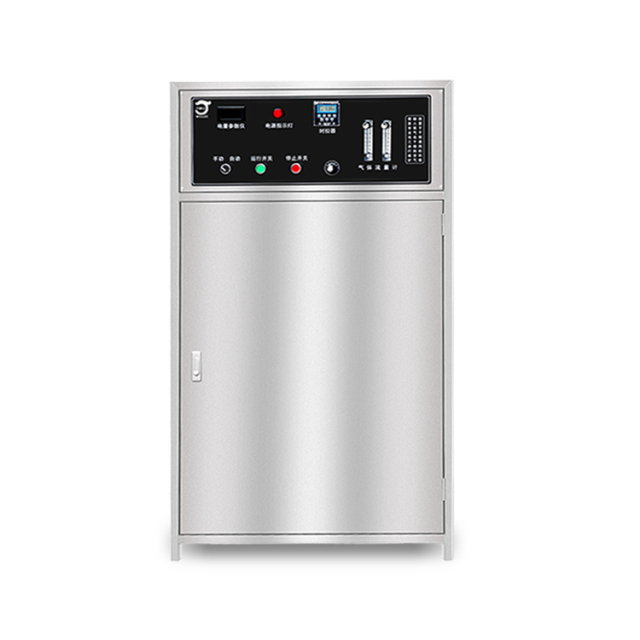
- A hinged front door with a metal latch opens the control and discharge side in one movement, giving clear access to the tube assembly, the switches and the wiring.
How the Ozone Is Produced
Ozone is made in the gap, not in a tank. Feed gas passes between two electrodes inside this ozone generator and a varying high voltage is applied across the gap; the micro-discharges that follow — corona, or silent discharge — split oxygen molecules into free atoms, and those atoms recombine with intact oxygen molecules as ozone (O3).
Only part of the electrical energy becomes ozone. The rest turns into heat inside the discharge gap, and hot ozone decomposes almost as quickly as it is formed, so the discharge assembly is water-cooled: the circuit takes the heat away at source and a water-cooled ozone generator holds its output steady through a long run instead of decaying as the tube warms.
Yield depends on two things the buyer controls — the quality of the feed gas and the temperature of the cooling water. Drier, cleaner, oxygen-rich gas and colder water both raise the share of the electrical input that leaves the machine as ozone, which is why an industrial water treatment equipment supplier keeps the air preparation inside the cabinet rather than on the site.
The dielectric in the discharge tube is quartz — the reason this is a quartz tube ozone generator rather than a ceramic-plate unit. Quartz has a high dielectric constant, a wall thickness that can be held uniform and good roundness, so the discharge is even along the tube and the material tolerates heat and moisture. Ceramic plates crack, and ceramic wall thickness and roundness are difficult to control, which produces uneven discharge; glass and enamel have a low dielectric constant and crack under the same heat.
Installation & Start-up
- Choose the position first: a level floor, a clear route in for the cabinet, and enough space at the front door to swing it open for service.
- Bolt the frame down if the unit stays put, or leave it on its castors and lock them.
- Lay in the services — cooling water supply and return to the two connections on this water-cooled ozone generator, and the ozone line from the outlet port to your injector or contactor.
- The point where this ozone generator for water treatment meets the rest of the plant is that single line, so plan its route before the cabinet arrives.
- Check the cooling circuit against the machine's requirement before the first start. As an industrial water treatment equipment supplier, we ask for flow and water temperature on every project, because those two numbers decide whether the rated output can actually be held in service.
- Connect the power supply named on the rating plate.
- High-frequency discharge is sensitive to a supply outside its tolerance, so avoid sharing the circuit with heavy switching loads without checking the arrangement with us first.
- Start up in sequence: air pump on, then ozone, then either set the timer or run in manual.
- Watch the gas flow meter and the digital power meter while the unit settles — an industrial ozone generator that is drawing and flowing as expected will hold its output.
- Finish with a leak check on the ozone line, confirm the gas-water separator is draining, write the timer settings down, and walk the operator through both modes before this quartz tube ozone generator is left to run.
Typical Applications
| Application | Typical duty |
| Small waterworks and community supply | Pre-oxidation ahead of filtration to break down iron, manganese, colour and taste compounds |
| Industrial process water | Oxidation of organics and residual colour before the water is used or discharged |
| Packaged and containerized sewage plants | Polishing and disinfection where an integrated ozone generator has to be installed on a small site |
| Food and beverage plants | Point-of-use treatment of process water and CIP rinse water |
| Aquaculture and hatcheries | Water quality control in recirculating systems where the plant room is tight |
| Pools, spas and leisure water | Supplementary oxidation in a small plant room |
| Odour control at pump stations and wet wells | Oxidation of odorous compounds in ventilated air or scrubber water |
Specifications
| Product specification | 80*48*140 (L *W*H CM ) |
| Ozone production | 10 0 (g/H) |
| Machine form | floor fixed/mobile |
| Shell material | 304 stainless steel |
| Operating voltage | AC220V/50HZ±5% |
| Rated power | 2.2KW |
| Ozone concentration | 80-120mg/L |
| Working frequency | 6.5KHZ |
| Output voltage | 4 kV |
| Outlet pressure | 0.08-0.1MPA |
| Ozone outlet | 10mm quick twist connector / DN15 optional |
| Cooling water inlet and outlet | Pagoda outer diameter 10 mm / DN15 optional |
| Cooling method | Water cooling water flow > 15L/min Water temperature |
| Use environment | Dry and clean, temperature |
Operating Modes & Controls
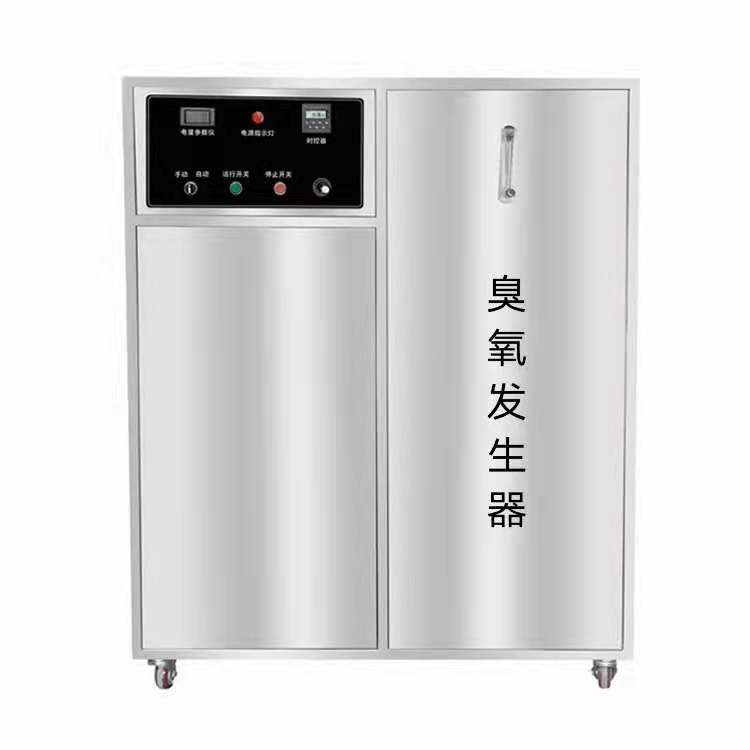
- Automatic, timed operation. Several sets of on/off periods can be programmed, with the timing error quoted at ± seconds per month, so this ozone generator can run unattended between site visits and still be off when nobody needs it.
- Manual operation.
- A switch takes the unit out of the timer and lets the operator run it on demand — useful for a short treatment, a test run, or a shift that does not follow the programmed pattern.
- Gas volume adjustment.
- A flow meter on the front panel sets the feed gas volume, so the duty can be matched to the water or air flow actually passing the injection point that day.
- Concentration adjustment, 5% to 100%.
- A concentration regulator on the machine spans the full range, so a gentler ozone concentration can be dialled in for a light duty and turned back up for a full one.
- Digital power parameter meter.
- Electrical readings sit on the panel where the operator can see them at a glance, which makes it obvious whether the machine is drawing what it should rather than leaving it to guesswork.
- Clear status indication.
- Working indicator light, air pump switch and ozone switch are grouped on the front panel, so the operating sequence of the machine is readable without opening the door.
Project Documentation & Ordering
- Start with the documents.
- The specification sheet carries the parameter table, the general arrangement drawing and the connection schedule for this model.
- As the ozone generator manufacturer we issue them for your project file, so your civil, pipework and electrical drawings can be checked against the same revision we build to.
- Send the duty point.
- Give us the flow, the ozone demand and the contact arrangement your ozone generator for water treatment has to serve, and we confirm whether this model fits or whether a larger frame in the range is the better answer.
- Check the site services.
- Cooling water flow and temperature, the power supply and the room conditions all go into the confirmation.
- Anything outside the standard list is settled before production rather than on site.
- Agree the configuration.
- Outlet and cooling-water fitting sizes, floor-fixed or mobile format, and any project-specific requirement are fixed at order stage, and the industrial ozone generator is then built to the drawing you approve.
- Confirm the commercial terms.
- Lead time, packing, shipping and payment terms are confirmed by your sales contact; we work to project schedules and will tell you clearly what is fixed and what depends on the order.
- Ask about pre-shipment inspection arrangements if your project requires them.
Technical Support & Model Matching
Send us your duty point, available utilities and site constraints, and our engineers will match a model from our range and confirm the configuration with you before anything is built — including custom designs where the project calls for it. That support continues after delivery: our technical team assists with installation and commissioning guidance, operator handover, fault finding and spare-part replacement, and we provide the drawings and specifications your project team needs. Share your process details and we will come back with a recommended model and a clear technical proposal.
FAQ
How does this model differ from the HMS small-scale ozone generators?
The HMS small-scale range is built as two pieces — a generator and a separate power supply cabinet — and covers duties from 500 g/h up to 3 kg/h. This unit is the compact alternative: a single integrated cabinet with the air supply, oxygen system and discharge all inside one enclosure. Both come from the same ozone generator manufacturer and both use water-cooled discharge, so the choice usually comes down to duty size and how much floor space you have.
Can the cabinet be installed outdoors or in a wet room?
It is a plant-room machine. The compressor and the oxygen system inside need clean, dry air around them, so the cabinet belongs in a plant room, a container or a purpose-built ventilated enclosure rather than in direct rain or heavy dust. If the only space you have is a semi-open area, tell us the conditions before the order and we will say whether an enclosure is needed.
How is the ozone connected into my water treatment line?
Ozone leaves the cabinet through the outlet port and is drawn into the water by the injector, venturi or contactor you have designed — the outlet connection and working pressure are both listed in the specification, and your injection equipment has to work at that feed pressure. Send us the arrangement you plan to use and we will check that the fittings and pressure suit it before the cabinet is built.
What routine maintenance does this ozone generator need?
Three things matter most. Keep the cooling water clean and at the rated flow, check that the gas-water separator is still draining automatically, and keep dust out of the cabinet interior so the fan can move air across the electrics. Beyond that, wipe the stainless shell down when the room is cleaned, inspect the ozone line joints periodically, and agree the discharge tube inspection interval with us for your duty cycle.
What happens if the cooling water stops or runs warm?
Output falls first and the discharge tube runs hotter than it should, so it is worth protecting the circuit. If your site cannot guarantee water at the rated flow, fit a flow switch or an alarm on the return line and tell us, so we can agree how it should be wired. Confirm the water temperature you can hold on site before ordering — it is one of the numbers the duty is checked against.