Product Overview
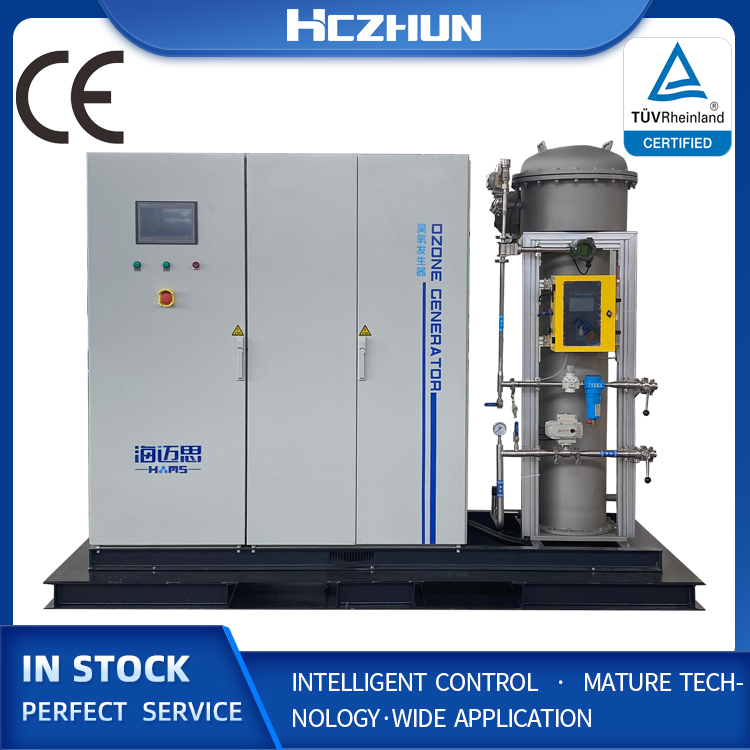
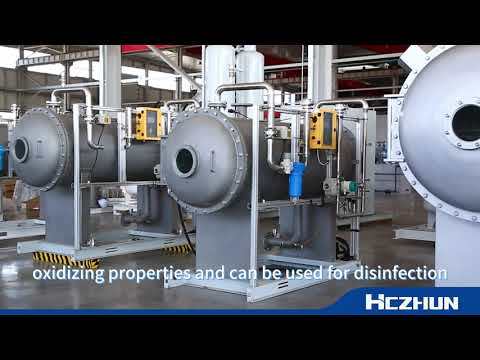
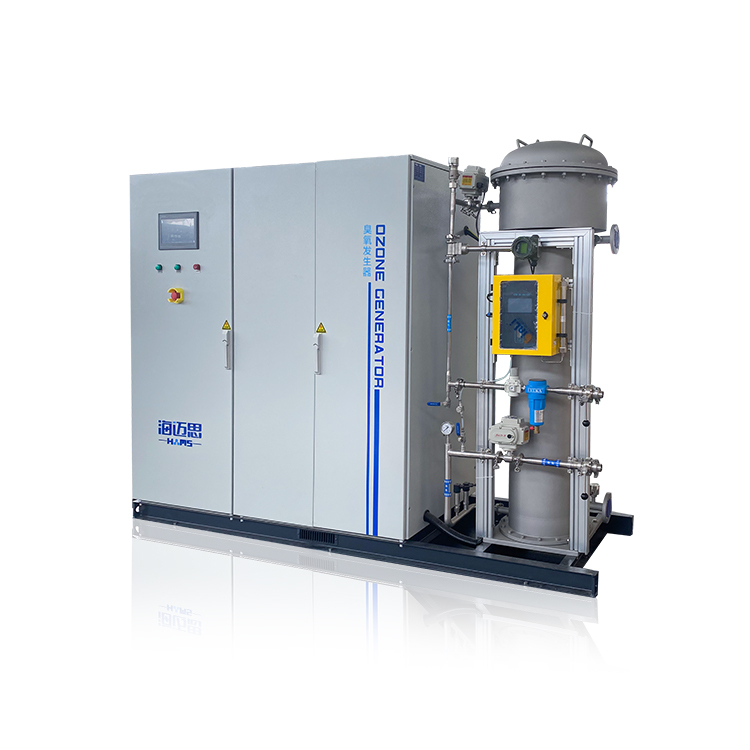
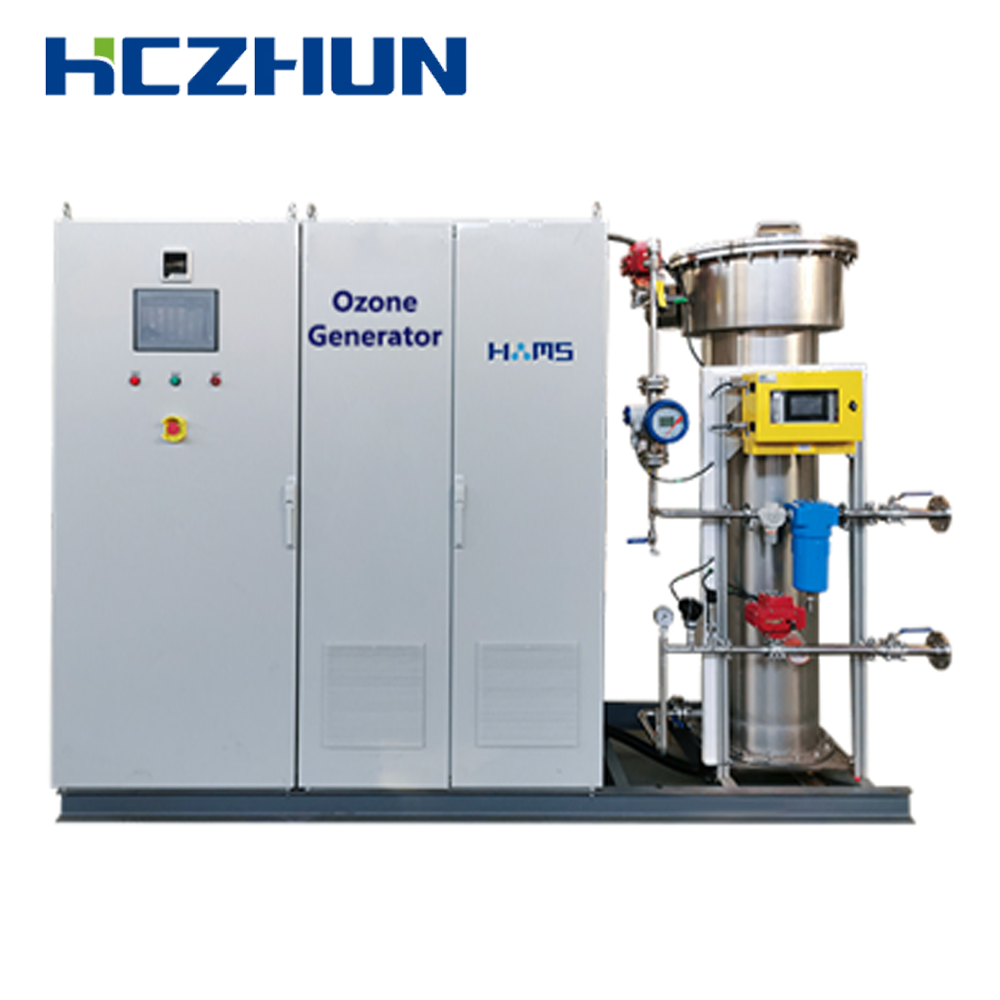
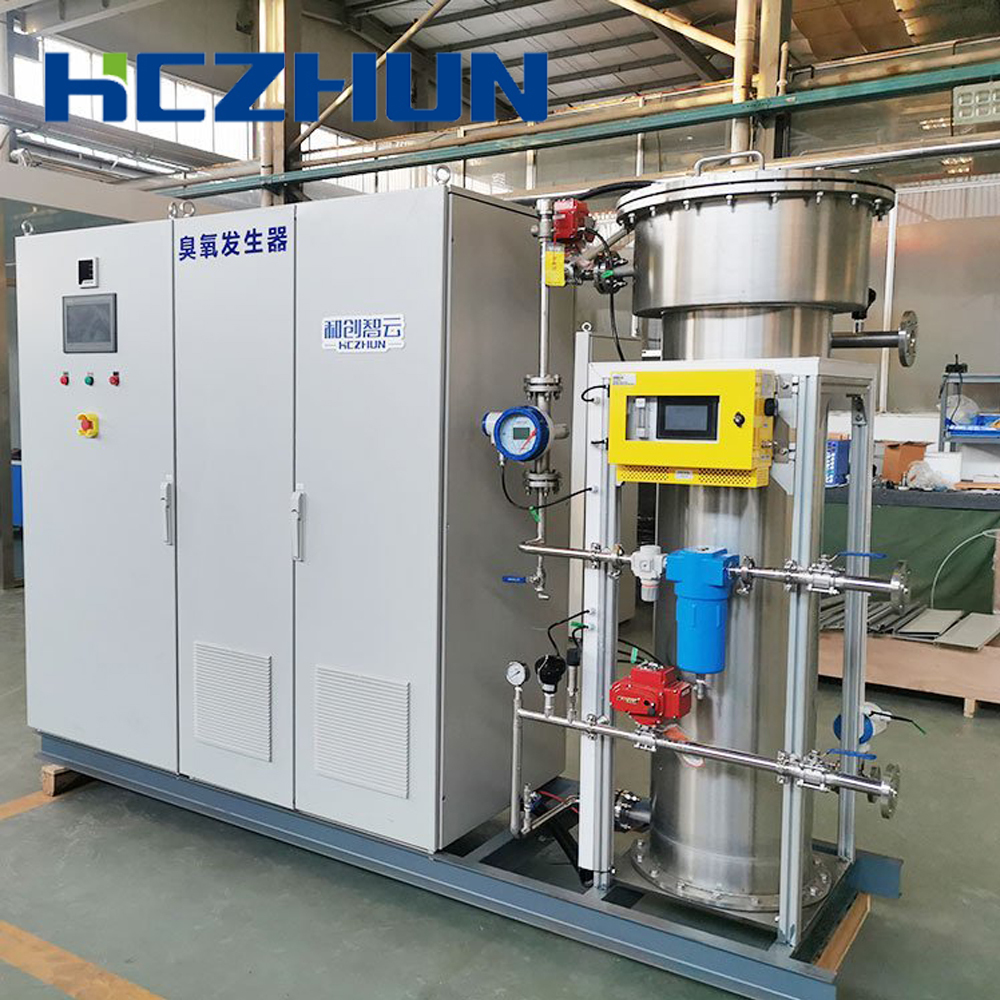
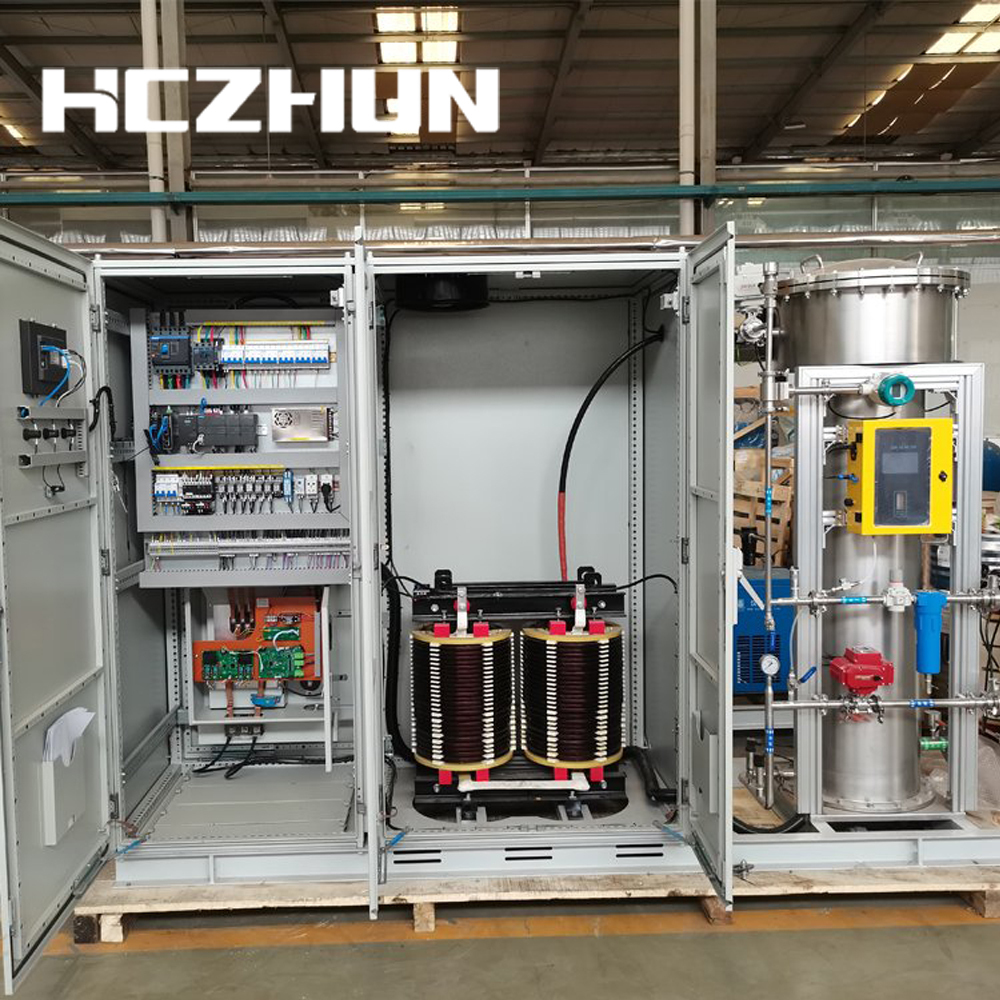
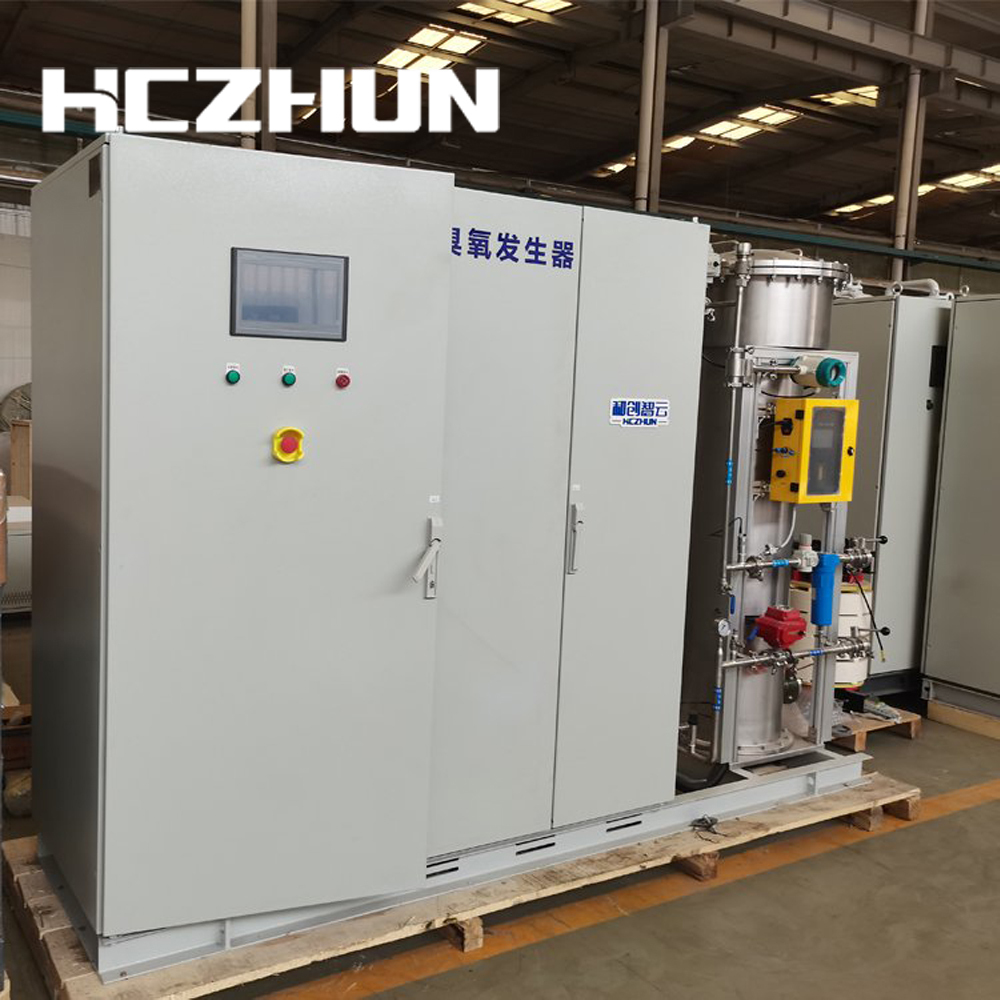
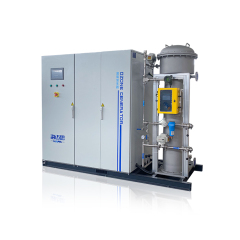
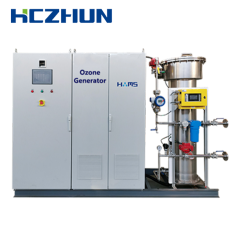
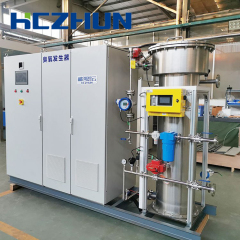
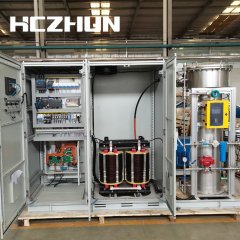
A packaged plant, a small municipal works or an industrial pre-treatment line usually needs ozone in the hundreds of grams to a few kilos per hour. That is enough for the duty and nowhere near the tonnage that justifies a generator hall, so the real problem is fitting a proper ozone supply into a plant room that was laid out before anyone thought about it. This small scale ozone generator covers that band from 0.5 kg/h to 3 kg/h across four HMS models. All four use the same corona discharge platform: a micro-gap double-layer discharge tube, a transformer and power supply chosen as a matched pair, water cooling, and a protection set that watches the electrics rather than waiting for a failure. Each unit leaves the works as a control cabinet and a cylindrical reactor vessel mounted on a common skid, with the process piping, valves and gauges already fitted. Site work is therefore setting the skid, then connecting cooling water, feed gas, power and the ozone outlet — not building an ozone generator in place. It suits project teams working to a defined duty: a disinfection stage, an oxidation step ahead of biological treatment, or odour control on a vent stream. One platform across four outputs. The 0.5, 1, 2 and 3 kg/h machines share the discharge tube family, the transformer and power-supply approach and the protection logic, so operating and maintenance routines carry over as a plant adds capacity. Designed as a matched set. Tube geometry, transformer parameters and cooling capacity are selected together for each model; changing one without the others is how a generator ends up either wasting power or running its tube hot. Built for continuous duty. These are not intermittent units — the cooling circuit, transformer and protection set are specified for round-the-clock operation, which is what a treatment stage actually asks of them. Trade-offs made in one direction. A wider discharge gap is cheaper to machine and more expensive to run; an oversized power supply looks generous on paper and wastes energy in practice. Every choice on this platform leans toward lower running cost and steadier output. Service access from the front. Hinged front doors give direct access to the electrical panel, protection circuits and monitoring boards without breaking into the process side of the skid. Scaled, not simplified. The small-capacity models use the same discharge and protection principles as the larger HMS machines, so a plant that later adds capacity is not switching to a different technology.
High Efficiency
Ozone is formed in the gap between two electrodes, and almost everything that decides efficiency happens inside that gap. A micro-gap double-layer discharge places a dielectric barrier on both sides of a narrow gap, so the micro-discharges spread across the tube surface instead of crowding into the path of least resistance.
Even spread is the whole point. Where a gap varies, the discharge concentrates at the widest point, that point runs hot, and ozone breaks down almost as quickly as it forms. Holding the gap uniform keeps more of the input energy in the reaction you are paying for and less of it in the cooling water.
The HMS discharge assembly uses a patented hexagon conductive plate to keep the field even across the plate face, and the unit is specified around an oxygen feed rather than ambient air, with the gas-source connection sized accordingly on each model.
On site this shows up as an ozone generator that reaches its rated output without being pushed. The power supply is not run at its ceiling to make nameplate output, so the tube stays inside its working temperature band through a long run and the output holds steady instead of fading across the shift.
Low Power Consumption
In a corona generator the power supply is not an accessory to the tube; the two are a pair, and the efficiency of that pair is what decides the electricity line in the operating budget. Transformer parameters on these models are chosen for the tube they feed, and the supply is sized to the tube's real demand rather than to a round number. Eight kilowatts per kilo of ozone whichever model you take, so an operating-cost estimate can be built from your own tariff before anything is ordered. Keeping excess energy out of the tube has a second effect. Heat that is never generated does not have to be removed, so the cooling circuit carries a lighter load and the water and chiller side of the installation stays smaller than it would be on a less well-matched design. For a plant running a small scale ozone generator through a full shift, this is the figure that repeats every month on the energy bill — and it is the number to put beside any alternative when a project compares operating costs.
Low Failure Rate
- Power protection technology.
- The supply is monitored and the unit is cut back or tripped when it drifts outside its window, so an incoming power problem does not become a tube failure.
- Protection against electrical breakdown.
- Breakdown inside a discharge chamber is the failure that destroys electrodes; the unit detects and isolates it before it can run away.
- Protection against fragmentation of chamber media.
- If a dielectric does break, the protection stops the machine rather than letting fragments and debris travel through the rest of the assembly.
- Dedicated monitoring protection circuits.
- Separate circuits watch operating conditions rather than relying on the main controller alone, so a fault trips at its source instead of being reported downstream.
- Faults stop the machine, they do not spread.
- The point of the four protections is that a problem becomes a shutdown with a cause to investigate, not a repair bill for the reactor and the power supply together.
- A shutdown you can diagnose.
- When a protection trips, the cause is identifiable at the machine rather than through a chain of downstream symptoms, which shortens the repair and gets the duty back on line.
Model Range and Sizing
- Establish the ozone demand in grams per hour: the required dose multiplied by the flow being treated.
- That single figure, not the plant's overall capacity, is what decides which model fits.
- Compare it with the range, which spans 500 to 3,000 g/h — that is 0.5 to 3 kg/h.
- A duty inside that band stays on this small scale ozone generator; a larger one moves up the HMS range.
- Check the feed gas.
- These models are specified around an oxygen source rather than ambient air, so the oxygen supply, its regulation and its dryness belong in the project plan from the start.
- Check the cooling water.
- The connection size steps up with the model, and the water has to be available at the flow, pressure and temperature that model expects — give us the conditions at your site and we will check them against it.
- Check the footprint.
- The skid grows with the model, and the 2 and 3 kg/h units take the longest base, so that is the one to plan the plant room around.
- Confirm the configuration.
Applications
The most common duty for an ozone generator for water treatment is disinfection: municipal or community supply, a packaged plant, or process water, where ozone is dosed into a contact tank and the residual is monitored at the outlet.
On an industrial ozone generator of this size, the second common duty is oxidation ahead of biological treatment — breaking down colour, COD or refractory organics so the biology downstream has less to do and the discharge target is easier to hold.
Odour control takes the same machine to a different place: pump stations, sludge handling areas, screening rooms and vent streams, where ozone is injected into the extracted air rather than into water.
Food and beverage plants use it for process water and rinse water, and for holding tanks where microbial control matters between production runs and the water cannot be held with a chemical residual.
In building services the unit is applied to duct and room treatment where odour and mould are the problem, which is the other half of what ozone is bought for alongside water purification.
Specifications
| Model | Ozone output · power draw · cooling water · gas source · net weight · dimensions |
|---|
| HMS-500 | 0.5 kg/h · 4 kW at 380 V · cooling water DN 20 · gas source DN 15 · 600 kg · 1,500 × 800 × 1,900 mm |
| HMS-1000 | 1 kg/h · 8 kW at 380 V · cooling water DN 25 · gas source DN 20 · 900 kg · 1,600 × 800 × 1,900 mm |
| HMS-2000 | 2 kg/h · 16 kW at 380 V · cooling water DN 32 · gas source DN 25 · 1,100 kg · 2,700 × 800 × 1,900 mm |
| HMS-3000 | 3 kg/h · 24 kW at 380 V · cooling water DN 40 · gas source DN 25 · 1,300 kg · 2,700 × 800 × 1,900 mm |
| Feed gas | Oxygen source, connected at the gas-source inlet |
| Cooling | Water-cooled, with the heat exchange module selected for the site |
| Discharge type | Micro-gap double-layer dielectric barrier discharge |
| Output control | Power pulse density modulation |
| Mounting | Control cabinet and reactor vessel on a common skid base |
Installation Requirements
- Set the skid on a level, load-bearing floor with clearance in front of the cabinet doors and around the reactor vessel for service access, and enough headroom to lift and place the unit.
- Connect the cooling-water circuit to the inlet and outlet on the model, with isolation valves and a drain so the circuit can be worked on independently of the rest of the plant.
- Connect the oxygen feed to the gas-source inlet.
- The line has to be clean, dry and regulated to the pressure the model expects; confirm the regulator, dryer and line materials with our engineers before the pipework is installed.
- Provide the three-phase supply, with cable and protection sized by a local electrician to the model, plus the control and instrumentation circuits the unit needs for its protection and monitoring functions.
- Connect the ozone outlet to the contactor or injection point using ozone-compatible materials, and keep the line as short and as free of dead legs as the layout allows.
- Commission in sequence: pressure-test the gas side, confirm cooling-water flow, then bring the output up in steps and verify it against the site's ozone monitor before handing the duty over to the control loop.
- Record the settings.
- Note the model, connection sizes and the output-to-power relationship at commissioning so later maintenance has a baseline to compare against.
Ordering and Delivery
- Start with the duty, not the model number.
- As an ozone generator manufacturer we size from the ozone demand, the feed gas and the utilities at your site, and confirm the model that fits before the order is released.
- Confirm the site utilities.
- Give us the cooling-water flow, pressure and temperature available, the oxygen supply arrangements and the electrical supply, and we will check them against the model rather than assuming them.
- Confirm what changes the build.
- Model, cooling package, connection sizes and outlet arrangement are fixed at order; changes after that point affect both cost and lead time.
- Lead time, payment terms and documentation are confirmed with your sales contact against the final configuration — ask for them in writing with the order confirmation.
- Packing and transport.
- Export packing, lifting points and transport dimensions are agreed per order; ask your sales contact for the packing arrangement that applies to your destination and site access.
- The wider treatment train.
- As an industrial water treatment equipment supplier we can provide the ozone unit alongside dosing and downstream treatment for the same project, so the interfaces are agreed once instead of between suppliers.
- Output you can turn down.
- Ozone production is regulated by power pulse density modulation, so the unit can follow a lower demand instead of switching between full output and nothing.
- More than one heat exchange module.
- The cooling package is offered in several configurations across the range, so it can be chosen for the water a site can actually supply rather than the other way round.
- Control-loop ready.
- Because output responds continuously, the generator can be driven from a dissolved-ozone or ORP controller and left to hold a setpoint through the day instead of being trimmed by hand at each shift change.
- Sited where the utilities are.
- Generating ozone from an oxygen feed and a cooling-water connection means there is no reagent delivery, bulk storage or dosing tank to accommodate alongside the skid.
- Feed gas planned once.
- Gas-source connections run from DN 15 to DN 25 across the range, so the oxygen supply line and its regulator can be planned against the duty rather than against the first unit bought.
- Connections stated per model.
- Cooling-water connections step from DN 20 to DN 40, a detail that matters on an industrial ozone generator where the cooling circuit often decides where the skid can sit.
- Document | What it covers --- | --- Model specification sheet | Output, power draw, connection sizes, net weight and dimensions for all four models Outline drawing | Skid, cabinet and reactor vessel dimensions with connection positions for your model Utilities schedule | Cooling-water, oxygen feed and electrical requirements per model, for the plant-room design Installation and commissioning guide | Siting, connection sequence and start-up checks Operation and maintenance manual | Normal operation, shutdown, routine inspection and fault indications Spare parts list | Wear items and the parts worth holding on site
Technical Support & Model Matching
As an ozone generator manufacturer we build to the duty, so send us your duty point, available utilities and site constraints and our engineers will match a model from our range and confirm the configuration with you before anything is built — including custom designs where the project calls for it. That support continues after delivery: our technical team assists with installation and commissioning guidance, operator handover, fault finding and spare-part replacement, and we provide the drawings and specifications your project team needs. Share your process details and we will come back with a recommended model and a clear technical proposal.
FAQ
Can the unit be installed inside an existing plant room?
Yes, provided the room can give it three things: a level floor with service clearance in front of the cabinet doors and around the reactor vessel, a cooling-water circuit, and an oxygen feed. The larger models take the longest skid, so that length plus working space is what the room has to accommodate. As an industrial water treatment equipment supplier we would rather confirm which model fits before you commit, so send us the room dimensions and the utilities you have.
What maintenance does the unit need between services?
The routine is inspection rather than replacement. Check the cooling-water circuit for flow and scale, confirm the oxygen feed is dry and at pressure, inspect the discharge assembly at the interval your duty calls for, and verify that the protection and monitoring circuits are healthy at each visit. Because faults trip at their source, the panel points you to which of those needs attention. Confirm the inspection interval for your model and duty with our engineers when the unit is handed over.
How does the unit follow a changing ozone demand?
Output is regulated by power pulse density modulation, which lets the discharge be turned down continuously rather than switched on and off. In practice that means an ozone generator for water treatment can be driven from a dissolved-ozone or ORP controller and hold its setpoint as flow and water quality move through the day, instead of being trimmed by hand at each shift change.
Can one unit cover both water and air duties?
The generator produces the same ozone either way; what changes is where it goes. A water duty needs an injection point and a contact tank, an air or vent duty needs an injection arrangement into the duct or vessel. Because the unit and its output control are unchanged, a site running both will normally size on the larger of the two duties and then split the ozone between them. As an industrial water treatment equipment supplier we can specify the contactor, monitor and injection point together with the unit instead of leaving them to be sourced separately.
When is a larger model the better choice?
This range stops at 3 kg/h. Above that, the duty belongs with the larger industrial ozone generator models, which use different frames, different cooling arrangements and a much larger footprint — the discharge principle carries over, the engineering around it does not. If your calculated demand sits close to the 3 kg/h ceiling with no room to expand around it, it is worth checking the next size up rather than running this unit flat out.